
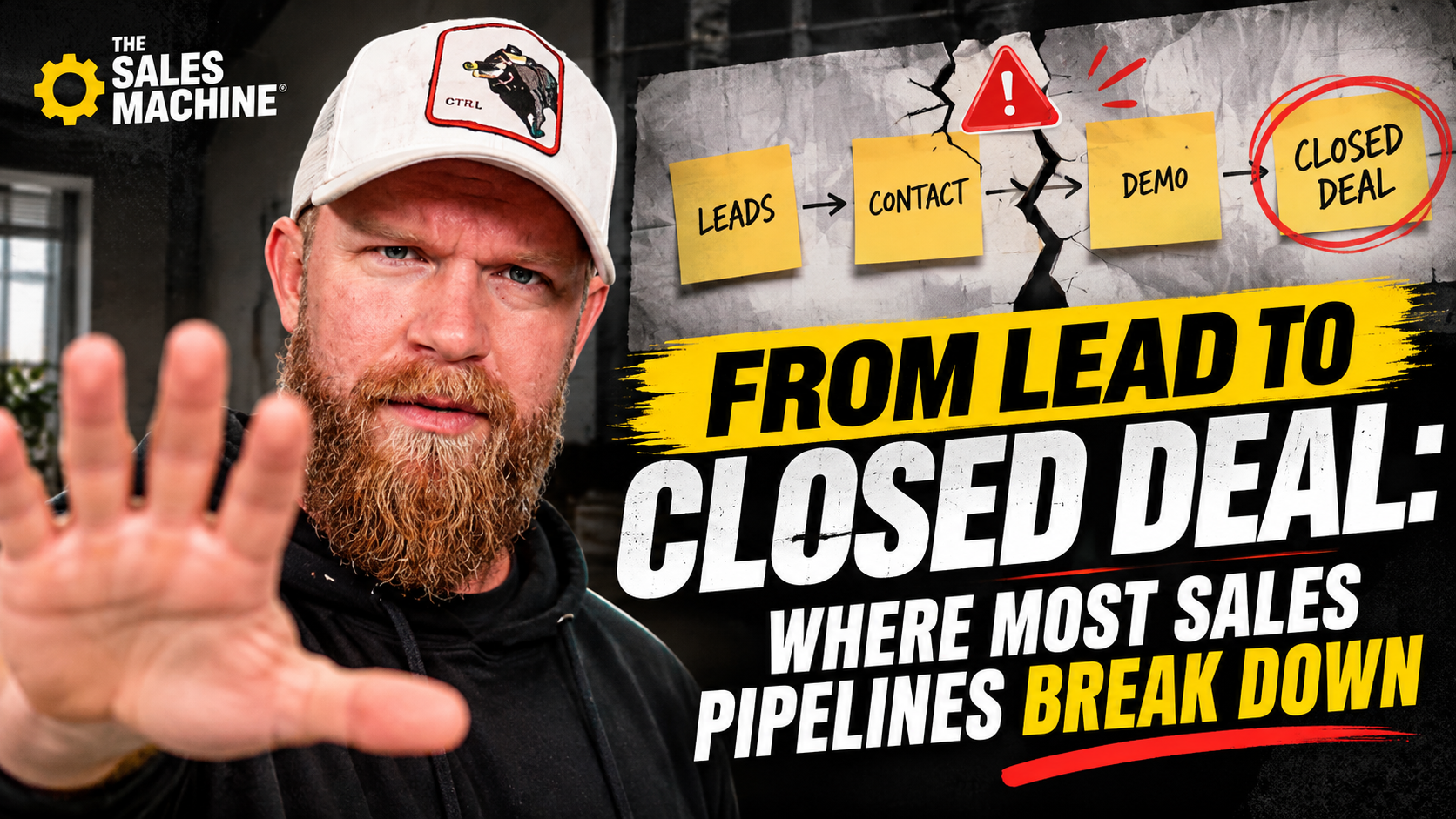
From Lead to Closed Deal: Where Most Sales Pipelines Break Down
By Taylor Robbins, Founder of Sales Machine
A lead comes in. Your team receives the notification, someone makes contact, and an appointment gets booked.
Everything seems to be working.
But then the prospect doesn't show up. Another expresses interest but never responds to follow-up messages. Someone else attends a sales call, asks questions, and promises to think about the offer before disappearing.
Eventually, your sales team is left wondering why so many opportunities aren't turning into paying customers.
This is a common problem for growing businesses. They generate leads, invest in salespeople, and implement CRM systems, yet revenue remains unpredictable.
The reason? A sales pipeline is only as strong as the process that moves prospects through it.
Every stage creates an opportunity to build trust, understand customer needs, and move a potential buyer closer to making a decision. But every stage also creates a potential point of failure.
If one part of the process isn't managed properly, the entire pipeline suffers.
In this article, we'll break down the most common stages where sales pipelines break down, why these problems happen, and what businesses can do to turn more leads into closed deals.
Key Takeaways
Sales opportunities can be lost at every stage of the pipeline, not just during the closing conversation.
Slow lead response can reduce the chances of connecting with interested prospects.
Poor qualification and appointment management create unnecessary pipeline inefficiencies.
Effective discovery, objection handling, and consistent follow-up help move prospects toward purchasing decisions.
CRM tracking and measurable sales KPIs help identify exactly where opportunities are being lost.
A structured sales process makes revenue more predictable and easier to scale.
1. The Lead Response Stage: Waiting Too Long to Make Contact
The first breakdown often happens before a salesperson even gets the chance to speak with a prospect.
A potential customer submits an inquiry, requests information, or fills out a form. Instead of receiving a timely response, the lead sits in a queue until someone becomes available.
By the time the sales team reaches out, the prospect may have already contacted another provider or lost interest.
This is particularly important for businesses running paid advertising campaigns. When prospects actively express interest, timing matters.
A delayed response can make your business appear unresponsive and reduce the momentum behind the inquiry.
Common problems at this stage:
New leads aren't assigned immediately.
Salespeople take too long to make the first call.
Leads get buried among older opportunities.
No clear system exists for handling incoming inquiries.
Teams rely on manual notifications instead of structured lead distribution.
How to fix it:
Establish a clear speed-to-lead standard. New inbound leads should be assigned and contacted as quickly as possible, with a target of under five minutes where operationally feasible.
Use CRM notifications, automated lead routing, and dedicated lead ownership to make sure every inquiry has someone responsible for it.
The objective is simple: respond while the prospect is still actively considering your solution.
2. The Qualification Stage: Spending Time on the Wrong Opportunities
Not every lead is ready to become a customer.
Some prospects are researching their options. Others may not have an immediate need, while some may not be the right fit for your product or service.
Without a proper qualification process, salespeople can spend hours pursuing opportunities that are unlikely to move forward.
This creates an overloaded pipeline and takes attention away from prospects who are more likely to buy.
However, qualification shouldn't become an excuse to dismiss potential customers too quickly.
A prospect who isn't ready to purchase today may still become a valuable customer later.
Common problems at this stage:
No clear ideal customer profile.
Salespeople make assumptions based on limited information.
Discovery questions aren't asked consistently.
Leads are marked as unqualified without documented reasons.
Sales teams confuse a lack of immediate urgency with a lack of interest.
How to fix it:
Create a qualification framework that helps salespeople understand each prospect's situation.
Focus on five important areas:
Need: What problem is the prospect trying to solve?
Budget: What financial considerations affect their decision?
Authority: Who is involved in approving the purchase?
Timing: When are they looking to make a decision?
Fit: Can your product or service realistically deliver the outcome they need?
Use these insights to determine the appropriate next step.
Some leads may be ready for a sales appointment, while others may need additional information or nurturing before entering the closing process.
Good qualification isn't about rejecting more leads. It's about understanding how to serve each prospect appropriately.
3. The Appointment Setting Stage: Booked Doesn't Mean Showed
Getting a prospect to book an appointment is a positive step, but it doesn't guarantee they'll attend.
Many businesses focus heavily on the number of appointments booked without paying enough attention to their show rate.
A calendar filled with appointments may look impressive, but if prospects consistently fail to attend, the business isn't generating as many real sales opportunities as it appears.
Consider this example:
A sales team books 100 appointments in a month, but only 60 prospects attend.
That means 40% of the booked opportunities never make it to an actual sales conversation.
The business has invested time and resources into generating appointments that don't produce meaningful sales interactions.
Common problems at this stage:
Prospects don't receive proper appointment confirmations.
Automated reminders are the only communication before the meeting.
Setters don't establish enough context for the appointment.
Prospects don't understand what they'll gain from attending.
No structured process exists for handling no-shows.
How to fix it:
Treat appointment setting as the beginning of the sales relationship, not simply a calendar-booking activity.
A strong appointment-setting process should include:
Confirm the prospect's interest and reason for booking.
Explain what the upcoming conversation will cover.
Send a confirmation immediately after booking.
Use reminders at appropriate intervals.
Have a team member personally reinforce the appointment when possible.
Create a clear process for rescheduling no-shows.
Remember, a booked appointment is an opportunity. A showed appointment is a real sales conversation.
Tracking both numbers helps managers understand whether the problem lies in appointment generation or attendance.
4. The Discovery Stage: Talking About the Product Before Understanding the Customer
One of the biggest mistakes salespeople make is jumping straight into the pitch.
A prospect joins a call, and the salesperson immediately starts explaining features, benefits, pricing, and available packages.
But there's an important step missing: understanding why the prospect is there in the first place.
Without proper discovery, salespeople risk presenting solutions that don't address the customer's actual concerns.
A prospect may be looking for better efficiency, lower operating costs, improved performance, or a solution to a problem that's affecting their business.
If the salesperson doesn't uncover these details, the conversation becomes a generic product presentation rather than a meaningful sales discussion.
Common problems at this stage:
Salespeople dominate the conversation.
Discovery questions are too general.
Customer pain points aren't explored deeply enough.
Salespeople assume they already understand the prospect's needs.
The proposed solution isn't connected to the customer's desired outcome.
How to fix it:
Train salespeople to lead with questions instead of presentations.
A useful discovery conversation should explore:
The prospect's current situation.
What isn't working.
Why the problem matters.
What they've already tried.
What an ideal outcome would look like.
What could happen if the problem remains unresolved.
For example, instead of immediately asking, "Would you like to hear about our service packages?" a salesperson could ask:
"What has been the biggest challenge with your current process?"
This encourages a more natural conversation and gives the salesperson useful information to guide the next steps.
The goal is to help prospects understand their situation before introducing a solution.
5. The Presentation Stage: Failing to Connect the Solution to the Problem
Once a salesperson understands the prospect's needs, the next step is presenting the solution.
However, another pipeline breakdown happens when salespeople rely on generic presentations instead of connecting their offer to the specific challenges discussed during discovery.
Listing features isn't the same as communicating value.
A customer may not care that a service includes ten different features if they don't understand how those features improve their situation.
Common problems at this stage:
Presentations focus too heavily on features.
Salespeople use the same pitch for every prospect.
Benefits aren't connected to specific customer problems.
The expected outcome isn't clearly explained.
Pricing is introduced before sufficient value is established.
How to fix it:
Make every presentation relevant to the prospect's discovery conversation.
A simple framework is:
Problem → Solution → Expected Outcome
For example:
Problem: Your sales team struggles to follow up with incoming leads consistently.
Solution: Implement a structured lead management and appointment-setting process.
Expected Outcome: More opportunities receive timely attention, creating a stronger path toward qualified sales conversations.
This approach helps prospects understand not just what they're buying, but why it matters.
The best sales presentations don't overwhelm customers with information. They show how a solution addresses the problems that matter most to them.
6. The Objection Handling Stage: Treating Every Concern as a Rejection
Not every prospect will immediately agree to purchase.
Some will ask about pricing. Others may need more time, additional information, or approval from another decision-maker.
These concerns are a normal part of the buying process.
However, sales pipelines often break down when salespeople treat objections as something they need to defeat rather than understand.
For example, when a prospect says, "It's too expensive," an inexperienced salesperson might immediately offer a discount.
But the actual concern could be something different:
They don't understand the return on investment.
They aren't convinced the solution will work.
They have concerns about implementation.
They need to discuss the decision with someone else.
They don't see enough urgency to act now.
Common problems at this stage:
Salespeople become defensive.
They respond before fully understanding the concern.
Discounts are offered too quickly.
They rely on rehearsed responses that sound unnatural.
They fail to distinguish between emotional and logistical objections.
How to fix it:
Encourage salespeople to slow down and understand the objection before responding.
A practical approach includes:
Acknowledge the concern.
Ask clarifying questions.
Identify the real reason behind the hesitation.
Address the concern with relevant information.
Confirm whether the prospect feels more confident about moving forward.
For example:
"I understand. When you say the investment feels high, is your main concern the upfront cost, or are you still evaluating whether the results would justify it?"
This keeps the conversation open and helps the salesperson understand what needs to happen next.
Remember, the purpose of objection handling isn't to pressure someone into buying. It's to help them make an informed decision.
7. The Follow-Up Stage: Letting Interested Prospects Go Cold
Not every deal closes during the first conversation.
Some prospects need additional time, while others are waiting for internal approval, comparing solutions, or working through financial considerations.
This is why follow-up is one of the most important parts of pipeline management.
Unfortunately, many sales teams don't have a consistent follow-up structure.
A salesperson might send one message after the call, wait a few days, and eventually stop contacting the prospect.
Without a defined process, interested opportunities can disappear simply because nobody manages the next step.
Common problems at this stage:
Follow-ups are inconsistent.
Salespeople forget to contact prospects.
No next action or deadline is recorded.
Messages offer no additional value.
Stalled deals remain in the pipeline without proper attention.
How to fix it:
Every active opportunity should have a documented next step.
A structured follow-up system should define:
Who is responsible for contacting the prospect.
When the next interaction should happen.
Which communication channel is appropriate.
What information needs to be provided.
What outcome the next conversation should achieve.
Follow-ups should also be personalized.
Instead of repeatedly asking, "Are you ready to move forward?" reference the prospect's previous concerns, answer outstanding questions, or share information that helps them evaluate the solution.
Most importantly, make sure every follow-up is recorded in your CRM.
If a deal has no next action, it is at risk of being forgotten.
8. The Closing Stage: Failing to Establish a Clear Next Step
The final stage is where all the previous conversations should come together.
The prospect understands their problem, sees the value of the solution, and has had an opportunity to address their concerns.
Yet even at this stage, deals can stall.
Sometimes salespeople fail to ask for a clear commitment. Other times, they leave the conversation without establishing what needs to happen next.
The result is an interested prospect who never makes a final decision.
Common problems at this stage:
Salespeople avoid asking for the sale.
The purchasing process isn't clearly explained.
Decision-makers haven't been identified.
Contract or payment steps are confusing.
No follow-up is scheduled after the proposal is sent.
How to fix it:
Make the closing process clear and straightforward.
Salespeople should:
Confirm that the solution addresses the prospect's needs.
Resolve any remaining questions.
Explain the investment and purchasing terms.
Identify any outstanding approvals.
Ask for a clear decision or commitment.
Explain exactly what happens after the prospect agrees.
A good closing conversation shouldn't feel like a sudden push to buy.
It should feel like a natural next step after a productive discussion.
9. How to Identify Where Your Sales Pipeline Is Losing Revenue
Understanding the different stages is only the beginning.
To improve performance, sales managers need to measure what happens between each stage.
Without reliable data, it's difficult to determine whether the issue comes from lead quality, appointment setting, sales conversations, or closing performance.
Start by tracking these essential metrics:
Metric | What It Measures | What a Weak Result May Indicate |
Speed-to-lead | Time taken to contact a new lead | Slow response or poor lead routing |
Contact rate | Percentage of leads successfully reached | Poor outreach or lead data quality |
Qualification rate | Percentage of leads that meet your criteria | Targeting or qualification issues |
Appointment booking rate | Leads converted into appointments | Weak initial conversations |
Show rate | Booked appointments that attend | Poor confirmation and appointment management |
Close rate | Sales conversations converted into customers | Discovery, presentation, or objection-handling issues |
Follow-up completion rate | Required follow-ups completed | Weak accountability or task management |
Sales cycle length | Time from lead entry to closed deal | Delays, stalled decisions, or process friction |
These metrics should be reviewed consistently, not just at the end of the month.
For example, if your appointment booking rate is healthy but your show rate is low, investing more in lead generation may not solve the problem.
The priority should be improving appointment confirmation and attendance.
Likewise, if prospects attend sales calls but rarely purchase, managers should review call recordings, discovery techniques, and closing conversations.
The most effective sales teams don't just measure how many deals they close. They understand what happens at every stage before the deal closes.
10. Build a Sales Pipeline That Moves Opportunities Forward
Once you understand where your pipeline breaks down, the next step is creating a repeatable system that prevents the same problems from happening again.
A strong sales pipeline should establish clear ownership, measurable expectations, and defined actions at every stage.
Here are five ways to strengthen your sales operation:
1. Define Every Pipeline Stage
Make sure salespeople understand what qualifies a prospect to move from one stage to another. Avoid vague stages that don't communicate the actual status of an opportunity.
2. Assign Clear Ownership
Every lead and active opportunity should have an assigned person responsible for the next action. This prevents leads from getting lost between team members.
3. Use CRM Automation Strategically
Automate repetitive tasks such as lead assignment, appointment reminders, task creation, and follow-up notifications. Keep human interaction where it matters most, especially during discovery and important sales conversations.
4. Review Sales Conversations Regularly
Call reviews help managers identify recurring issues that numbers alone cannot explain. Use them to coach salespeople on discovery, communication, objection handling, and closing.
5. Create a Consistent Coaching and Accountability System
Review pipeline performance weekly, identify bottlenecks, and provide specific coaching based on actual results.
A sales process should be continuously improved as your business, customers, and market conditions evolve.
The goal is not to create unnecessary complexity. It's to make sure every opportunity has a clear path forward.
Frequently Asked Questions
What are the most common reasons sales pipelines break down?
The most common causes include slow lead response, poor qualification, low appointment show rates, weak discovery conversations, ineffective objection handling, inconsistent follow-up, and poor pipeline visibility.
What is the most important stage of a sales pipeline?
Every stage matters because each one influences the next. However, lead response and appointment management are particularly important because they determine whether a prospect reaches an actual sales conversation. Without that conversation, there is no opportunity to present or close the deal.
How can I improve my sales pipeline conversion rate?
Start by identifying where prospects drop off. Review conversion rates between stages, examine sales call recordings, improve follow-up processes, and provide targeted training to address specific performance gaps.
How often should sales managers review their pipeline?
Sales managers should monitor important activity and pipeline indicators daily, conduct structured pipeline reviews weekly, and evaluate broader conversion trends monthly. The frequency can vary depending on sales volume and the length of the sales cycle.
Can a CRM system prevent sales pipeline breakdowns?
A CRM can improve visibility, accountability, and consistency by tracking leads, interactions, follow-ups, and deal stages. However, a CRM is only effective when the team follows a defined process and keeps the information updated.
How do appointment setters and closers work together?
Appointment setters focus on connecting with prospects, understanding initial interest, and scheduling qualified conversations. Closers take those conversations further by exploring needs, presenting solutions, addressing objections, and guiding prospects toward a purchasing decision. Both roles need clear communication and shared pipeline visibility.
Final Thoughts: Every Stage Matters in Closing a Deal
A successful sale rarely happens because of one perfect conversation.
It happens because multiple steps work together.
From the moment a prospect submits an inquiry to the moment they become a paying customer, every interaction influences their decision.
A delayed response can cost you the opportunity. Poor qualification can waste valuable sales time. An ineffective discovery conversation can make your offer irrelevant. And inconsistent follow-up can allow an interested prospect to disappear.
That's why businesses need to look beyond their final closing numbers.
If you want more deals to close, understand what happens before the closing conversation.
Build a process that responds quickly, qualifies thoughtfully, books meaningful appointments, serves prospects through better conversations, and maintains consistent follow-up.
Because a strong sales pipeline isn't simply a list of potential customers.
It's a system that moves the right opportunities forward, creates better customer experiences, and turns more conversations into revenue.
Ready to Find the Gaps in Your Sales Pipeline?
If your business is generating leads but struggling to convert them into paying customers, The Sales Machine can help you identify where opportunities are getting lost.
From appointment setting and lead management to sales training, CRM optimization, and pipeline accountability, building a stronger sales operation starts with understanding what's happening at every stage.
Book a FREE Sales Audit with The Sales Machine to uncover your pipeline bottlenecks and discover opportunities to improve your team's performance.

