
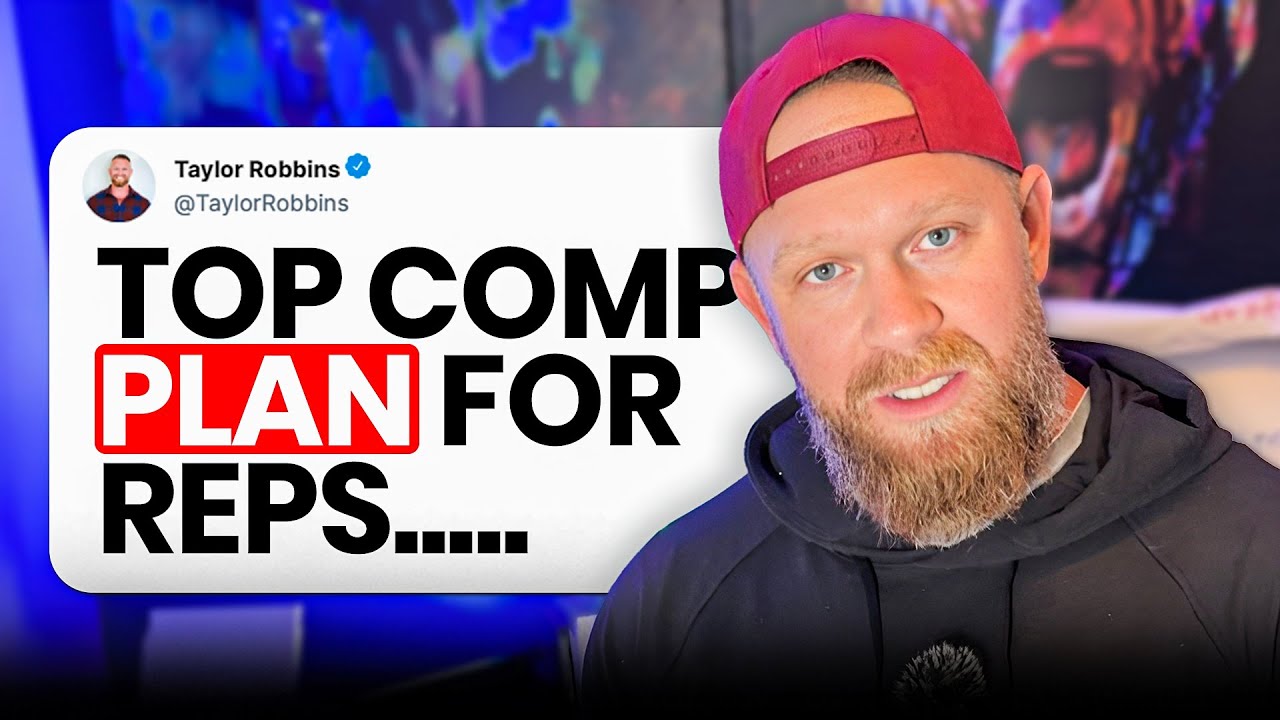
Sales Compensation Plan: The 5-Layer Structure
By Taylor Robbins, Founder of Sales Machine — updated May 2026
A sales compensation plan is the formal structure that defines how sales reps get paid — base salary, commission rates, bonus triggers, and recognition. The right plan aligns rep behavior with business outcomes by stacking five distinct layers: tiered commissions, forward-rolling bonuses, self-generated multipliers, activity scoreboards, and non-cash recognition. After 12+ years building sales teams in the seven- and eight-figure range, the single most reliable lever for performance is not training, hiring, or coaching — it's the comp plan.
Key Takeaways
Comp plan determines talent quality — a $50K–$100K OTE attracts entry-level reps; a $200K base with $1M+ OTE attracts enterprise closers with a book of business. The structure dictates who applies.
Tier commissions by performance — paying 9% under $100K cash collected, 11% from $100K–$150K, and 15% above $150K rewards productivity per opportunity, not raw revenue.
Roll bonuses forward, don't pay cash — a $200K stretch goal earns a higher commission rate next month (e.g., 10% → 13%), keeping the activity engine running instead of triggering a post-bonus slowdown.
Self-generated business gets a multiplier — paying 15% on referrals vs. 10% on company-provided leads finally makes reps actually ask for referrals.
Activity scoreboards beat sales scoreboards — leading indicators (dials, speed-to-lead, touches) create daily competition; recognition for top performers should be experiential, not cash.
What is a sales compensation plan?
A sales compensation plan is the documented structure that determines how a sales rep earns money, broken into fixed pay (base salary) and variable pay (commissions, bonuses, SPIFs, and accelerators). It defines the rates, triggers, payout schedule, and total OTE (on-target earnings) for each role. A well-designed comp plan aligns incentives between the rep and the business so the activities that drive revenue — dials, conversations, closed deals, retained customers — also drive the rep's paycheck.
Most B2B companies treat the comp plan as a contract artifact. It's actually the operating system of the sales team. If reps aren't doing what you need them to do, the plan is broken before the rep is.
Watch the full breakdown on YouTube
How comp plan structure dictates the talent you attract
OTE is the most-read line on any sales job posting. According to a 2025 Bridge Group SaaS AE compensation survey, the median enterprise AE at a B2B SaaS company earned roughly $260K OTE — split 50/50 between base and variable. Cut OTE in half and you're competing for SDRs, not closers. Push OTE past $300K with a $200K base and you're targeting reps with a decade of industry experience and a book of business they can bring.
The takeaway: decide who you want to hire first, then build the plan to attract them. If you're hiring high-ticket service closers selling $5K–$50K offers, an OTE in the $120K–$200K range with aggressive variable pay attracts the right profile. If you're hiring enterprise strategic AEs, the base has to be high enough to weather a 6-month ramp.
This is also where most founders get it wrong. They post a $60K base + 10% commission role expecting closers with five years of experience and wonder why nobody applies. The market clears at a known rate. Don't fight it — outbid it where it matters or move to a different segment.
Want this done for you instead of figuring it out yourself?
Sales Machine builds and runs B2B appointment setting for companies with established sales teams — fully managed, no SDR headcount required. We bring the dialers, the AI, the human setters, and the systems. See if we're a fit →
Layer 1: Tiered commission structure on cash collected
The base commission rate is the floor. The tiers are where behavior changes.
In high-ticket B2B sales — services, agency work, software with implementation fees — commission rates typically range from 10% to 20% of cash collected. The first decision is cash collected vs. contract value. Cash collected is safer for cash flow because the company pays the rep only when revenue lands in the bank. Contract value rewards reps for closing larger deals up front but forces the company to front the payout against future payments — and creates incentive misalignment if deals go sideways (clawbacks, churn, refunds).
A hybrid model works for most companies: a portion paid on cash down at close, the remainder paid as payments come in. That keeps the rep engaged with the post-sale customer-success motion rather than disappearing after the deal lands.
Then add tiers. A simple example:
Monthly cash collectedCommission rate Under $100K9% $100K – $150K11% $150K+15%
The pushback founders give: "Why would I pay a higher percentage on more revenue?" Because the rep isn't getting more opportunities — they're getting the same lead flow and converting more of it into cash. Customer acquisition cost stays flat, so you're partnering with the rep on the margin gained from higher productivity. The accelerator pays for itself.
This is also a recruiting tool. Top reps read comp plans backward, from the highest tier down. If your top tier is competitive, they'll apply. If it isn't, they won't.
Layer 2: Forward-rolling bonuses (not cash)
This is where most comp plans leak. Traditional bonus structures pay a lump-sum cash bonus when a rep hits a stretch goal. The problem is the day after a big month.
Picture a rep who hits the stretch ($200K in a month), pockets a $5K cash bonus, then looks at the next 30 days. They worked harder than they have all year. Their first instinct is to coast. Cash bonuses purchase a great month and a mediocre month back-to-back.
The fix: make the bonus a commission rate increase for the following period.
A rep at a 10% base rate hits the $200K stretch. Next month, their commission rate becomes 13% on every deal. The structure changes the rep's incentive on Day 1 of the new month: every dial, every demo, every close is worth more — so they push harder, not less. Hit it again, the elevated rate carries forward.
This compounds. A rep at 13% who hits next month's stretch rolls to 15%. After three strong months they're earning at a rate that costs the business meaningfully more — but the business is also generating meaningfully more cash. Aligned.
If you ever need to reset, build a quarterly recalibration into the plan. That's preferable to clawing back rates mid-quarter and torching trust.
Layer 3: Self-generated business multiplier
Almost every B2B sales team is bad at referrals. Every founder asks for them. The reps say yes. Nothing happens.
The reason is simple. Reps make the same commission whether they sit on the calendar and wait for marketing-sourced leads or hustle for referrals from happy customers. There's no incentive to do the harder thing.
Fix it with a flat multiplier. Standard rate on company-sourced leads is 10%. Self-generated business pays 15%.
Now the math is different. A rep working 100% off the calendar makes $X. A rep who self-generates 30% of their pipeline makes $X plus a 50% premium on that portion. According to a 2024 HubSpot research summary, referrals close at 3–5x the rate of cold leads — so the rep also closes faster, with less effort per deal. The multiplier just makes the math visible.
A few mechanical rules to make it work:
Define "self-generated" precisely. Past customer referral, partner intro, LinkedIn outbound the rep did on their own time. Not a marketing-qualified inbound lead the rep happened to call.
Attribute referrals to the rep who asked. Even if the lead routes to someone else, the original rep earns the referral spread on the close.
Track referrals in the CRM as a lead source. No source tag = no premium.
The first 60 days after rolling this out, referrals typically double. Reps will start every customer-success call with "who else do you know who'd want to talk to us?" because the comp plan finally rewards them for it.
Layer 4: Activity scoreboard (leading indicators, not lagging)
Commissions and bonuses reward the lagging indicator — cash collected. If a rep is short on cash for the month, the comp plan provides no day-by-day feedback loop. By the time the gap shows up in the sales report, the month is gone.
The fix is an activity scoreboard that converts leading indicators into points, and ties bonus payouts to point totals.
Leading indicatorDaily targetPoint per hit Outbound dials250/day1 point Average speed-to-lead< 2 minutes1 point per lead caught in time Total touches per lead8 in 4 days1 point per lead fully touched
In a 22-working-day month with ~5 fresh leads per rep per day, this generates around 120 available activity points monthly. Then bonus on points, not dollars:
80 points: $500 cash bonus
120 points: $700 cash bonus
Perfect score: $1,000 cash bonus
This is the one place cash bonuses work — because they reward the process, which is sustainable, instead of rewarding a single outsized result, which isn't.
The scoreboard itself also serves a second purpose: visibility. Every rep sees every other rep's point total in real time. Joe falling behind Timmy at 11 AM on a Friday will dial 40 more times by 3 PM. According to research from Gartner on sales incentives, public scoreboards drive a measurable lift in activity even when no cash is attached, because the social pressure does what compensation alone can't. Combine the two and you compound.
Layer 5: Non-cash recognition
The final layer is the cheapest and the most under-used.
When a rep hits sales rep of the month, sales rep of the quarter, or sales rep of the year, don't pay them cash. They'll mentally combine the cash bonus with the rest of their commission check and forget it ever happened.
Instead, give them something they wouldn't buy for themselves:
A nice watch they'd never expense
A pair of designer sneakers
Courtside tickets to a Mavericks or Lakers game
A weekend at a five-star hotel for them and their partner
A custom suit fitting
The cost to the business is often less than the equivalent cash bonus, but the psychological weight is 10x higher. The rep tells the story. Their family sees the gift. New hires want to win the next one. Recognition compounds in a way money can't.
Pick three tiers — monthly, quarterly, annual — and lock them in. Reps need to know exactly what they're competing for.
Comp plan vs. compensation philosophy: where most founders break
A comp plan is a document. A compensation philosophy is the principle underneath it.
The philosophy at Sales Machine, after 12+ years and 200+ sales hires across multiple companies: comp plan should pay reps what the business can sustain at scale, not what feels comfortable at the founder level. If the only way the plan works is when reps don't hit quota, the plan is wrong. If reps hitting quota tanks the company's margins, the plan is wrong in the other direction.
The four diagnostic questions:
Does the plan attract the talent we want? If the inbound applicant pool is the wrong profile, the OTE is wrong.
Does the plan reward the right behaviors? Cash collected, fast follow-up, full touch sequences, referrals — does the rep earn more for doing all four?
Does the plan compound performance? A rep having a great month should be set up to have a better month next, not a worse one (the cash-bonus trap).
Does the plan survive a great quarter? When five reps overperform simultaneously, is the company more profitable or less? Bad accelerators bankrupt good months.
If any answer is "no," the plan needs a rebuild — not a tweak.
Frequently Asked Questions
What is a good commission percentage for sales reps?
For high-ticket B2B service or SaaS implementation sales, commissions typically range from 10% to 20% of cash collected, with tiers that scale up as monthly cash collected increases. Lower-priced transactional sales (sub-$1K AOV) often run 5%–10%. Enterprise reps with $200K+ bases usually see commission rates under 10% because total OTE is achieved through deal size, not rate.
Should sales bonuses be paid in cash or as higher commission rates?
Paying a cash bonus rewards a single performance moment and often triggers a post-bonus slowdown. Converting the bonus into a commission rate increase for the following month carries the rep's earning power forward, which rewards the same achievement and drives continued activity at the same time. Cash bonuses still work well for activity scoreboards — process metrics — but not for revenue stretch goals.
How do you motivate sales reps to ask for referrals?
Pay a higher commission rate on self-generated business. If company-sourced leads pay 10% and referrals pay 15%, reps will start asking on every customer-success touchpoint because the incentive is finally aligned with the effort. The multiplier has to be tracked precisely in the CRM with a lead source field so the comp calculator can apply the spread automatically.
What's the difference between commission on cash collected vs. contract value?
Cash collected means the rep is paid commission only when revenue actually arrives in the company bank account. Contract value means the rep is paid based on the total deal size at signing, regardless of when payments come in. Cash collected protects the company's cash flow and reduces clawback risk; contract value rewards reps who close larger deals up front. Hybrid models pay a percentage at close on cash down and the remainder as installments come in.
How do you build a sales scoreboard that actually drives activity?
Track leading indicators — dials per day, speed-to-lead under 2 minutes, total touches per lead — not just closed revenue. Convert each indicator hit into a point. Display the scoreboard publicly so every rep sees every other rep's totals in real time. Tie cash bonuses to point thresholds. The combination of social transparency and financial incentive drives sustained daily activity in a way a monthly revenue dashboard can't.
How often should you change a sales compensation plan?
Quarterly recalibration is the maximum cadence for material changes. Mid-quarter changes — especially clawbacks of accelerator rates — destroy trust and trigger turnover. The right rhythm: lock the plan for a full quarter, measure outcomes against the four diagnostic questions, adjust at the quarter boundary if needed, communicate changes 30 days before they take effect.
Ready to scale outbound without rebuilding your sales team?
Sales Machine has booked thousands of qualified meetings for B2B clients with $3M+ in revenue and 5+ sales reps — using a done-for-you setter team, the AI stack to power it, and the systems to keep it running. If your closers are good at closing but your pipeline is inconsistent, that's the gap we fix.
No pitch. We diagnose your pipeline live and tell you whether we (or anyone) can help.
About the author: Taylor Robbins is the founder of Sales Machine, a done-for-you B2B appointment setting agency that combines AI voice agents, automation, and human SDRs to book qualified meetings for clients in tech, consulting, financial services, and B2B industrial. Taylor has hired and managed 200+ sales reps across multiple seven- and eight-figure businesses over the past 12+ years.
Related reading
How To Fix The 5 Biggest Sales Team Mistakes — common comp-plan and process pitfalls
Copy Our Client's 7-8 Figure Sales Pipeline Strategy — the pipeline structure these comp plans pay against
AI Did Not And Will Never Kill Human SDRs — why the AI + human hybrid still wins

