
Sales Onboarding Process: A 14-Day Plan for New Reps
A sales onboarding process is the structured set of steps that takes a new rep from signed offer to producing on live calls. The strongest versions combine self-paced training, live certification, a shadow day, and daily manager recaps. Brandon Hall Group research, cited by SHRM, found that strong onboarding improves new-hire retention by 82% and productivity by over 70%.
By Taylor Robbins, Founder of Sales Machine, updated November 2026
Key Takeaways
Onboarding is a 14-day system, not a week of shadowing. Two days self-paced, two days live, one shadow day, then five days of live calls with daily recaps.
Certify before you release. Quizzes inside a learning management system (LMS) prove competency before a rep touches a live lead.
Structure and recruiting decide whether onboarding works. A rep placed in the wrong role, or hired from a resume instead of a video, fails no matter how good your training is.
Pay on qualified shows, not booked calls. Setters paid per booked call optimize for volume, not for the calls your closers actually want.
Daily recaps for five days are cheap insurance. Thirty to 45 minutes a day tells you whether the hire is working before you've sunk months into them.
Why Most Sales Onboarding Fails
Here's the pain. You hire a closer, drop them on the calendar, spend $5,000 to $10,000 on ads feeding them calls, and watch them close one deal. They tell you they just need more time. You give it to them. It doesn't work out. You start over.
That's not a talent problem. It's a system problem. I've hired about 200 remote salespeople across my own companies, starting in 2013 with my first six or seven reps at a high-ticket fitness business. That first group did not go well. After 12 years and multiple seven-figure high-ticket businesses, the pattern is clear: reps fail because the structure around them is broken, not because the people are bad.
Replacing reps is expensive. According to SHRM, one recruiting executive estimates the cost of recruiting, hiring, and onboarding a single employee can reach $240,000. And early exits are common: a Work Institute report, summarized by Delinea, found that 37.9% of employees who leave an organization do so within their first year.
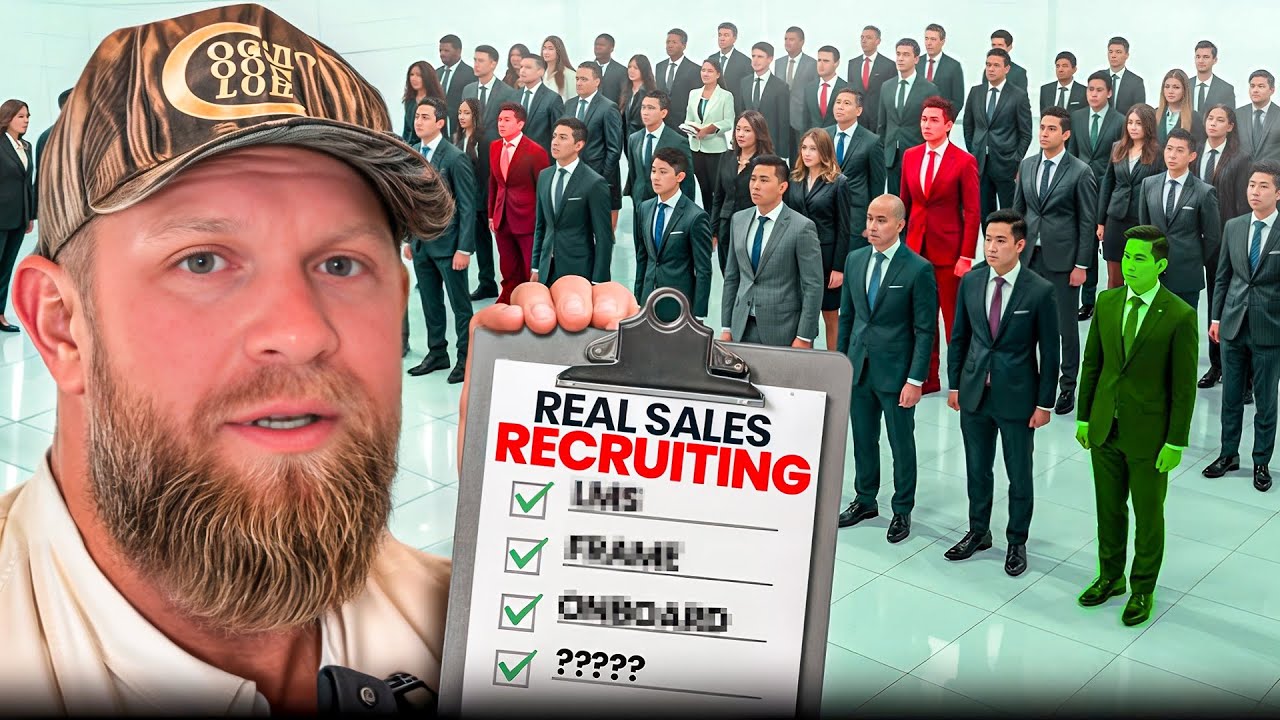
Onboarding is the last of three pieces. To make it work, you need the right frame (your sales org structure), the right recruiting process, and then the 14-day ramp. Skip the first two and the third can't save you.
What Does a Sales Org Structure Need Before You Onboard Anyone?
A sales org needs ascension: defined steps a rep can climb. Without it, you're hiring a finished closer with nothing to grow into, and the good ones leave.
The structure I use has four levels:
Junior setter. Books qualified appointments. Often an offshore hire on a base of around $10 an hour.
Senior setter. Same job, proven KPIs. Base of around $15 an hour.
Hybrid closer. Runs their own outbound and closes the calls they book.
Senior closer. Closes the highest-value inbound calls.
A junior setter graduates to senior setter after about three months of hitting their KPIs. Be honest about the wall that sits between setting and closing, though. Setting is activity-driven. Closing is skill-driven. Some setters cross over, and I've seen it happen, but most won't, so hire at both levels and let people graduate within their lane.
Why a Hybrid Closer Beats a Commission-Only Closer
Most founders go straight for the commission-only inbound closer. The closer interviews well, says they don't do outbound because they're "past all that," and you put them on a calendar of $100-to-$500 calls.
The hybrid closer fixes the risk. Hybrid closers earn around 15% of cash collected because they set their own appointments: they outbound leads, build their own pipeline, and close the inbound calls too. You can hand them a list of dormant leads and see whether they reactivate them. That's less financial risk than burning ad spend on a stranger, and it gives them far more at-bats talking to live prospects.
Because your outbound script is part and parcel of your closing script, they learn your avatar faster. Later they move to senior closer at 10% to 15% of cash collected. At 10% full time, a former hybrid who was doing half outbound is earning more than they did at 15% half time.
How to Pay Setters So They Book Calls That Show
Pay setters on qualified shows, not booked calls. Everyone in this space has a show-rate problem and a lead-quality problem, and per-booking commission makes both worse. Define your ideal client profile (ICP) clearly, then pay something like $10 per qualified show for juniors and $15 for seniors.
For closers, a base plus commission removes what I call commission breath. In my experience, a base around $5,000 plus 5% to 10% of cash collected lets people pay their bills and perform. That's also the model I've described Alex Hormozi using at Gym Launch.
One more trick: tie the bonus to next month, not this one. If a closer hits $100K cash collected and gets a one-time $2K kicker, they reset to zero and coast. Instead, tell them hitting $100K moves them from 10% to 12% or 13% on everything next month. They stay hungry through the month-end rollover.
Want this done for you instead of figuring it out yourself?
Sales Machine builds and runs AI + human appointment setting for B2B companies, with top-performing setters, no SDR hiring, and no training on your side. Get top-performing setters →
Source video: watch the full breakdown on YouTube
How Should You Recruit Salespeople Before Onboarding Them?
Skip the resume. Your reps will sell on Zoom, on camera, so make the first filter a video application: two to three minutes, curated, using a video-ask tool. I don't care where they went to school.
The process has four stages, and each one narrows the pool:
Video application. Big pool in, fast filter out.
Group interview. If they don't show, they're filtered. Confident candidates encourage the others. Ego narcissists surface quickly. Ask one candidate what another just said and you'll know who actually listens.
Culture interview. One-on-one, before skills. Do they match your core values? Would you enjoy spending time with them? A highly skilled jerk is still a jerk, and on a sales floor that's a cancer.
Skill interview. Three or four unprepared role-plays. Hand them a money objection and start immediately. You see skill level, not rehearsed answers.
The reason for the rigor is documented. A 2015 Brandon Hall Group and Glassdoor study, cited by SHRM, found that organizations without a standardized interview process are five times more likely to make a bad hire.
The 14-Day Sales Onboarding Process, Step by Step
This is the on-ramp I use. The goal is a rep performing quickly, and counterintuitively it takes less time than the drawn-out ramp most teams run.
Days | Phase | What happens | Proof it worked |
|---|---|---|---|
1-2 | Self-paced LMS | Scripts, winning call recordings, CRM, tech stack, SLAs, contracts, product and prospect training | Quizzes passed |
3-4 | Live onboarding | Script drills, role-plays, listening to live calls, tech verification | Competency tested live |
5 | Shadow day | Rep shadows your top closer or setter for a half day, camera off | Top rep's written feedback |
6-10 | Live, half-time | Rep takes live calls with a daily recap | Manager recap passes |
11-14 | Release | Daily touchpoints taper, rep runs solo | Hits KPIs or doesn't |
Days 1-2: Self-Onboard and Certify
Build a learning management system as a simple course. Include your call scripts, recordings of winning calls, CRM training, your tech stack (calendar, Zoom, integrations), service-level agreements, and contracts. Add product training and prospect training.
Then require certification. Quizzes inside the LMS prove competency, so you aren't guessing.
Days 3-4: Live Onboarding
This is where you test that competency live. Drill the script. Role-play. Listen to real calls together and talk through them in real time. Verify the tech stack: confirm they're logged into everything and that your round-robin calendar routing is set up correctly.
Day 5: Shadow Day
The new hire joins the top closer's day, camera off, for half a day. The top closer shares their screen and shows how they take notes, disposition leads, and send email follow-up. Setters do the same with your best setter.
Afterward, ask the top performer for feedback. Did the new hire ask questions? Were they paying attention? That's data you can't get anywhere else.
Days 6-10: Live Half-Time With Daily Recaps
Now the rep goes live at half-time, with a daily recap with you or the sales manager. Review whether they:
Take correct notes in the CRM
Follow the script
Confirm calls properly
Hit speed-to-lead
Follow your other KPIs and processes
It's cumbersome. Expect a 30-to-45-minute touchpoint every day for five days.
Days 11-14: Release
At day 14, you release the leash. They rock it or they don't. But you now have the best possible read on whether this person will work out, and you got it in two weeks.
What Does This Look Like Compared to a Typical Ramp?
Most teams don't have a defined process, so ramp becomes whatever happens. According to a Hyperbound summary of research from Sailes, sales ramp time has climbed to about 5.7 months on average.
That's the gap a defined process attacks. Here's how the approaches compare:
Approach | Structure | Time to first live call | Quality signal |
|---|---|---|---|
Hire and hope | None | Day 1 | Revenue after months |
Shadow-only | Informal | Week 1-2 | Subjective |
14-day certified ramp | LMS, live drills, shadow, daily recaps | Day 6 (half-time) | Quizzes plus daily recap by day 10 |
I'm not claiming a rep is fully ramped at day 14. Full ramp depends on your sales cycle and offer. The claim is narrower and more useful: by day 14 you know whether the hire is going to work, and you've spent two weeks finding out instead of five months.
Common Sales Onboarding Mistakes
Mistake 1: Treating onboarding as a one-time event. The recaps in days 6 through 10 matter as much as the training. Reps pick up bad habits fast when nobody is looking.
Mistake 2: Skipping certification. Without quizzes and a live competency test, "trained" means "sat through videos."
Mistake 3: Hiring a closer before you have a pipeline. A commission-only closer with no outbound and no lead flow can't prove themselves. That's why I prefer hybrid closers.
Mistake 4: Paying setters per booked call. You get calls that don't show. Pay on qualified shows.
Mistake 5: Hiring on resume and charisma. Video applications, group interviews, culture interviews, and unprepared role-plays beat both.
Where Sales Machine Fits
At Sales Machine, we run this as one system. Our team has booked more than 67,000 qualified sales calls over five years, and the hiring structure, pay design, and 14-day ramp described here come from the same playbook we use with clients. Our work with 50+ teams across a dozen industries is what we package as the Sales Machine Playbook.
If you're a B2B company with an established sales team, our appointment setting service takes the setter side off your plate entirely. If you want to build the team yourself, use the framework above and browse more breakdowns on the Sales Machine blog.
Frequently Asked Questions
How long should a sales onboarding process take?
A structured sales onboarding process can run 14 days: two days of self-paced training, two days of live onboarding, a shadow day, and about five days of live calls with daily recaps. Full productivity takes longer and depends on your sales cycle, but two weeks is enough to know whether the hire is working.
What should be in a sales onboarding program?
Include call scripts, recordings of winning calls, CRM and tech stack training, service-level agreements, contracts, product training, and prospect training. Then add certification quizzes, live role-plays, a shadow day with your top rep, and daily manager recaps during the first live week. Training without certification only proves attendance.
How do you onboard remote salespeople?
Run the same process over Zoom. Reps self-onboard in a learning management system, certify through quizzes, then complete live drills on video. On the shadow day, the top closer shares their screen to show note-taking, dispositioning, and follow-up. Daily Zoom recaps with the manager keep new hires accountable without micromanagement.
Should you pay setters per booked call?
No. Pay setters per qualified show instead. Booked-call commission rewards volume, and most teams already struggle with show rate and lead quality. Defining your ideal client profile and paying on qualified shows, such as $10 for junior setters and $15 for seniors, aligns the setter with what your closers actually need.
Is a hybrid closer better than a commission-only closer?
For most high-ticket teams, yes. A hybrid closer, paid around 15% of cash collected, sets their own appointments and closes them. That lowers your financial risk because they can work dormant lead lists, and it gives them more live conversations, so they ramp faster than a closer who only receives inbound calls.
How do you hire salespeople without resumes?
Use a video application of two to three minutes, then a group interview, a culture interview, and a one-on-one skill interview with unprepared role-plays. Each stage narrows the pool. You see how candidates communicate on camera, treat others, and handle objections before you spend ad dollars on them.
Ready to scale your sales onboarding process without the hiring headaches?
We've booked more than 67,000 qualified sales calls over five years, and the same hiring, pay, and ramp principles in this article run inside every team we build. If you're a B2B company with $3M+ in revenue and an existing sales team, let's see whether it makes sense to work together.
No pitch. We look at your pipeline and tell you whether we, or anyone, can help.
About the author: Taylor Robbins is the founder of Sales Machine, a done-for-you B2B appointment setting agency that combines AI, automation, and top-performing human setters. He has hired about 200 remote salespeople across multiple seven-figure high-ticket businesses since 2013.

