
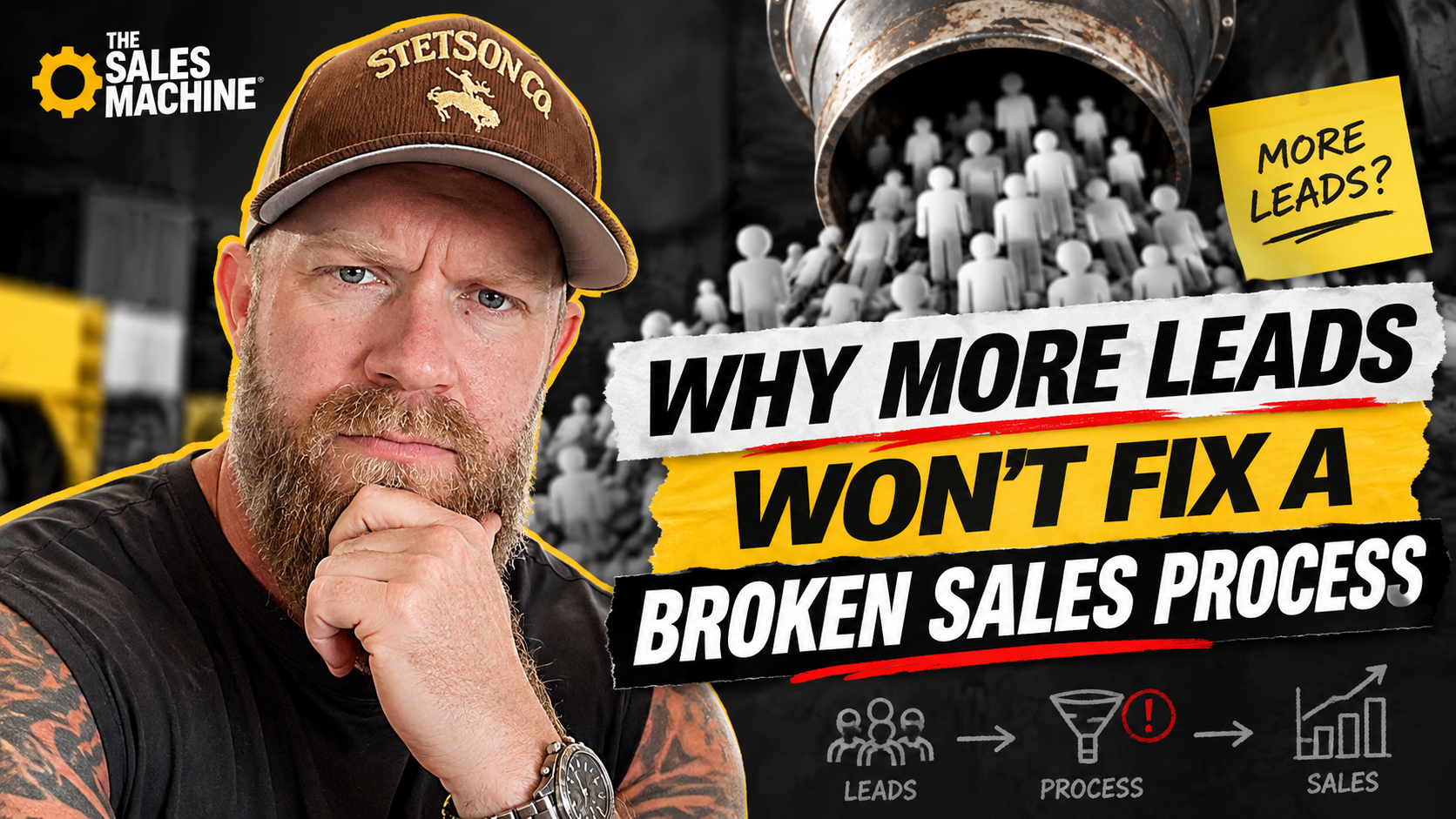
Why More Leads Won’t Fix a Broken Sales Process
Why More Leads Won’t Fix a Broken Sales Process
By Taylor Robbins, Founder of Sales Machine, updated November 2026
When sales numbers start falling, many businesses turn to the same solution: generate more leads.
They increase advertising budgets, expand prospecting efforts, hire appointment setters, or invest in new lead generation tools. The expectation is simple: more leads should eventually mean more customers and higher revenue.
But what happens when the leads keep coming in and sales remain stagnant?
The problem may not be your lead generation strategy. It may be what happens after a prospect enters your sales pipeline.
If your team struggles with slow follow-ups, inconsistent sales conversations, poor qualification, weak objection handling, or ineffective pipeline management, adding more leads will only increase the pressure on an already struggling system.
More leads cannot compensate for a sales process that consistently loses opportunities.
For businesses looking to scale, the priority should be building a sales system that can effectively convert existing opportunities before investing heavily in generating new ones.
Here's why fixing your sales process should come before increasing lead volume.
Key Takeaways
More leads do not automatically translate into more revenue.
Poor follow-up, weak qualification, and inconsistent sales execution can cause valuable opportunities to disappear.
Increasing lead volume without improving sales operations creates additional costs and workload.
Sales managers should identify conversion bottlenecks before increasing acquisition spending.
A repeatable sales process, supported by proper training, CRM management, and performance tracking, creates a stronger foundation for growth.
1. More Leads Won't Solve Poor Conversion Rates
Imagine your business generates 500 leads every month, but only a small percentage become paying customers.
Your first instinct might be to increase that number to 1,000 leads.
However, if your sales team is already struggling to convert the existing 500, doubling your lead volume won't necessarily improve revenue.
It may simply double the number of opportunities your team struggles to manage.
Before increasing lead generation, understand how effectively your team moves prospects through the sales pipeline.
Consider these questions:
How many leads are successfully contacted?
How many prospects book a sales appointment?
How many booked appointments actually show up?
How many sales conversations turn into qualified opportunities?
How many opportunities eventually become paying customers?
These numbers help identify whether the issue is lead quality, sales execution, or something happening between the different stages of your pipeline.
Instead of immediately investing in more leads, identify where your current opportunities are being lost.
The goal isn't simply to generate more conversations. It's to create more meaningful sales opportunities that lead to revenue.
2. Poor Follow-Up Causes Valuable Opportunities to Disappear
Not every prospect will make a purchasing decision during the first conversation.
Some need additional information. Others need time to evaluate their options, discuss the investment, or get approval from other decision-makers.
This is where follow-up becomes essential.
Unfortunately, many sales teams rely on individual salespeople to remember when and how to contact prospects again.
Without a structured follow-up system, some leads receive multiple touchpoints while others are forgotten entirely.
Even interested prospects can lose momentum when communication becomes inconsistent.
A strong follow-up process should establish:
When salespeople should contact prospects after the initial interaction.
How frequently follow-ups should happen.
Which communication channels should be used.
What information or value should be provided during each interaction.
How every conversation and next step should be recorded.
Follow-up should also be more than sending repeated messages asking whether someone is ready to buy.
Each interaction should help the prospect make a more informed decision.
A consistent follow-up system ensures that opportunities don't depend entirely on a salesperson's memory or availability.
3. Your Sales Team May Be Attracting or Accepting the Wrong Leads
Generating hundreds of leads means very little if most of them aren't the right fit for your offer.
Without clear qualification criteria, salespeople can spend valuable time speaking with prospects who lack the budget, authority, urgency, or actual need for the solution.
This creates unnecessary work and makes the pipeline appear healthier than it really is.
For example, a business selling high-ticket services may generate plenty of inquiries, but many prospects may only be looking for free advice or inexpensive alternatives.
The issue isn't necessarily the number of leads. It's whether those leads match the business's ideal customer profile.
A reliable qualification process should help salespeople understand:
Need: Does the prospect have a problem your business can solve?
Budget: Can they realistically afford your solution?
Authority: Are they involved in making the purchasing decision?
Timing: Are they planning to address the problem soon?
Fit: Does your solution align with their goals and expectations?
When qualification becomes part of the sales process, your team can spend more time helping prospects who have a genuine reason to buy.
The objective is to prioritize quality opportunities rather than simply filling the pipeline.
4. Inconsistent Sales Conversations Lead to Inconsistent Results
Even when businesses generate qualified leads and schedule appointments, the sales process can still break down during the actual conversation.
One salesperson may be excellent at building rapport but struggle with objections. Another may understand the product but fail to ask the right discovery questions.
Some salespeople follow a structured approach, while others improvise every conversation.
This inconsistency makes it difficult to predict performance and identify what actually works.
A successful sales team needs more than product knowledge. Salespeople must understand how to guide prospects through a conversation, uncover their needs, communicate value, and address concerns.
This requires a documented sales process and consistent training.
Consider establishing clear standards for:
Opening and building rapport.
Asking effective discovery questions.
Understanding the prospect's pain points.
Connecting the offer to the prospect's needs.
Handling objections without becoming pushy.
Communicating the next steps and closing opportunities.
Training should also include regular call reviews, role-playing, feedback, and coaching.
The goal isn't to make every salesperson sound exactly the same. It's to ensure everyone follows a proven framework while maintaining a natural and customer-focused approach.
When sales conversations become more consistent, managers can better understand performance gaps and help their teams improve.
5. Poor Pipeline Management Makes Growth Difficult to Predict
If your business doesn't have a clear picture of what's happening inside its sales pipeline, scaling becomes a guessing game.
Managers may know how many leads were generated last month, but they may not know how many are actively being pursued, which opportunities are stalled, or why deals aren't moving forward.
Without proper pipeline management, important information gets scattered across spreadsheets, emails, personal notes, and individual calendars.
A customer relationship management (CRM) system helps centralize this information and gives sales managers better visibility into team performance.
At a minimum, your CRM should track:
Lead source and contact information.
Assigned salesperson.
Current pipeline stage.
Previous interactions and follow-up history.
Qualification status.
Scheduled appointments.
Next actions and deadlines.
Closed-won and closed-lost opportunities.
However, simply having a CRM isn't enough.
Your team must consistently update records and follow clearly defined pipeline stages. Managers should also review the pipeline regularly to identify stalled opportunities and overdue activities.
A well-managed pipeline makes it easier to understand what's happening, where support is needed, and what actions can improve revenue performance.
6. Adding More Leads Can Increase Your Operating Costs
Lead generation requires resources.
Whether you're investing in paid advertising, outbound prospecting, appointment setters, or additional marketing personnel, generating more leads comes with additional costs.
If your sales process isn't converting opportunities effectively, increasing lead volume can make the financial situation worse.
Consider a simplified example:
Metric | Current Process | Increased Lead Volume |
|---|---|---|
Monthly Leads | 500 | 1,000 |
Conversion Rate | 5% | 5% |
New Customers | 25 | 50 |
Cost Per Lead | $20 | $20 |
Lead Generation Cost | $10,000 | $20,000 |
In this example, doubling lead volume doubles acquisition spending while keeping the same conversion rate.
The business may generate more customers, but it hasn't improved the efficiency of its sales process.
Now imagine improving the conversion rate from 5% to 8% while maintaining the original 500 leads.
The business would generate 40 customers instead of 25 without needing to double its lead generation budget.
These figures are illustrative, but they demonstrate an important principle: improving conversion efficiency can create meaningful growth without immediately increasing acquisition spending.
Before investing more money into lead generation, make sure your existing sales system is making the most of the opportunities it already receives.
7. Sales Managers Need to Fix the Bottleneck, Not Just Increase Activity
One of the biggest mistakes in sales management is treating every performance problem as an activity problem.
When revenue drops, managers may tell salespeople to make more calls, send more emails, or book more appointments.
While activity is important, increasing it won't automatically solve the underlying issue.
For example:
Lots of leads but few appointments? Review targeting, messaging, and initial response times.
Appointments booked but low attendance? Improve appointment confirmation and qualification.
Good attendance but few sales? Review discovery conversations, value communication, and objection handling.
Many interested prospects but few closed deals? Examine follow-up, decision-making barriers, and closing effectiveness.
Inconsistent salesperson performance? Review training, coaching, and management standards.
Every stage of the sales process should have measurable performance indicators.
Some important metrics to monitor include:
Sales Metric | What It Reveals |
|---|---|
Lead-to-contact rate | How effectively your team reaches incoming leads |
Lead qualification rate | Whether you're attracting the right prospects |
Appointment booking rate | How effectively leads become sales conversations |
Show rate | How many booked prospects attend |
Closing rate | How effectively salespeople convert opportunities |
Average deal value | The average revenue generated per customer |
Sales cycle length | How long it takes to close a deal |
Follow-up completion rate | Whether salespeople consistently manage opportunities |
These metrics help managers move beyond assumptions and make decisions based on actual sales performance.
The most effective approach is to identify the biggest bottleneck, address it, and measure whether the improvement produces better results.
8. Build a Sales System That Can Handle Growth Before Scaling
Once you've identified the weaknesses in your sales process, the next step is creating a system that can consistently support your business.
A scalable sales process doesn't depend on one high-performing salesperson or a manager constantly reminding everyone what to do.
It should provide clear expectations, repeatable workflows, and measurable standards across the entire team.
Start with these five fundamentals:
1. Standardize Your Sales Process
Document every stage, from the first interaction to the final purchase decision. Make sure everyone understands their responsibilities and what needs to happen before an opportunity moves forward.
2. Invest in Consistent Sales Training
Provide ongoing training in discovery, communication, objection handling, and closing. Use real sales conversations to identify opportunities for improvement.
3. Improve CRM and Pipeline Management
Centralize customer information, track interactions, and establish clear rules for updating opportunities.
4. Establish Accountability and Performance Standards
Set realistic activity and performance expectations. Review individual and team results regularly, and use the data to guide coaching.
5. Combine AI Efficiency With Human Judgment
Automation and AI can help manage repetitive tasks, organize lead information, and support appointment booking. However, human judgment remains important when understanding customer needs, handling complex conversations, and building trust.
A combination of technology, structured processes, and capable salespeople creates a stronger foundation for sustainable growth.
Frequently Asked Questions
Why isn't my business converting more leads into sales?
Several factors can affect lead conversion, including poor lead quality, slow follow-up, inconsistent sales conversations, ineffective objection handling, and unclear qualification criteria. Review your sales funnel to identify where prospects are dropping off.
Should I generate more leads or improve my sales process first?
If your existing leads aren't being handled or converted effectively, improving your sales process should generally come first. Once your team has a repeatable process and enough capacity to manage additional opportunities, you can scale lead generation more confidently.
How do I know if my sales process is broken?
Common warning signs include inconsistent conversion rates, missed follow-ups, poor CRM management, low appointment attendance, unpredictable revenue, and significant differences in salesperson performance.
Can automation fix a broken sales process?
Automation can improve efficiency by handling repetitive tasks, scheduling follow-ups, organizing information, and supporting appointment booking. However, it cannot independently fix unclear sales procedures, poor communication, or inadequate sales training. Your processes should be established before automating them.
What should sales managers focus on to improve closing rates?
Sales managers should evaluate lead quality, qualification standards, discovery conversations, objection handling, follow-up consistency, and individual salesperson performance. Regular coaching and data-driven reviews help identify which areas need improvement.
When should a business start scaling its lead generation?
A business should consider scaling when it has a clearly defined target audience, a repeatable sales process, measurable conversion rates, consistent follow-up, and sufficient sales capacity to handle additional opportunities.
Final Thoughts: Fix the Process Before Feeding the Pipeline
Generating more leads can create opportunities for growth, but only when your sales operation is equipped to handle them.
If your team consistently loses opportunities because of poor follow-up, weak qualification, inconsistent sales conversations, or ineffective management, increasing lead volume won't address the underlying problem.
It will simply give your business more opportunities to lose.
The better approach is to evaluate your existing sales process, identify where revenue is leaking, and build a system that helps your team perform consistently.
Improve how leads are handled. Strengthen your sales training. Make your pipeline visible. Use data to guide decisions and establish accountability across the team.
Then, once your process is working, scale your lead generation with confidence.
Because sustainable sales growth doesn't come from having the most leads. It comes from having a sales system that knows how to turn the right opportunities into revenue.
Ready to Find What's Holding Your Sales Team Back?
If your business is generating leads but struggling to turn them into consistent revenue, it may be time to look beyond lead generation.
The Sales Machine helps businesses identify sales bottlenecks, improve sales team performance, strengthen pipeline management, and build systems designed for predictable growth.
Book a FREE Sales Audit with The Sales Machine and discover where opportunities may be slipping through your sales process.
About the author: Taylor Robbins is the founder of Sales Machine, a done-for-you B2B appointment setting agency that combines AI, automation, and top-performing human setters. He was Alex Hormozi's first and top closer and has built multiple seven-figure sales organizations.

